
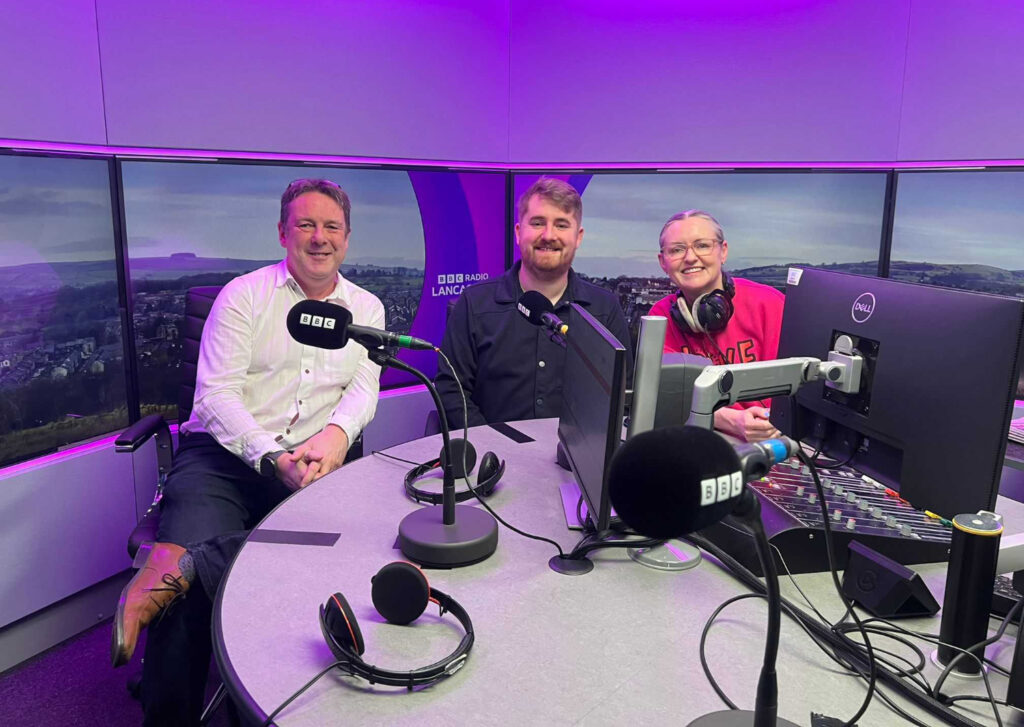
AI Works Featured on BBC Radio Lancashire
Key Topics Discussed
- What artificial intelligence actually is
- How AI has existed for decades but only recently became widely known
- Where AI already appears in everyday technology
- The risks of AI-generated content and misinformation
- Opportunities for businesses adopting AI tools
- Career opportunities in AI and software development
From the Interview
“AI has actually been around for decades, people just didn’t call it AI.”
Darren Bentham
“Businesses often think AI is a magic bullet, but it works best when it’s introduced carefully into existing workflows.”
Kyle Iddon
About The Guests
Darren Bentham has been working with artificial intelligence since 1992 and specialises in AI consultancy, training, and software development.
Kyle Iddon is a software developer who began his career as an apprentice and has spent more than a decade building AI-powered software solutions for businesses.
Together they run The AI Works, a consultancy helping organisations understand and implement artificial intelligence safely and effectively.
Interview Transcript
Darren Bentham has been working with artificial intelligence since 1992 and specialises in AI consultancy, training, and software development.
Kyle Iddon is a software developer who began his career as an apprentice and has spent more than a decade building AI-powered software solutions for businesses.
Together they run The AI Works, a consultancy helping organisations understand and implement artificial intelligence safely and effectively.
Read The Full Interview Transcript
Sharon Hartley:
Artificial intelligence is something a lot of people are talking about at the moment, and I’m not bothered about putting my hands up and saying this, it fries my brain. AI is transforming our world. It’s everywhere and increasingly becoming part of our everyday lives.
Experts predict its importance will only grow in the coming years. But what are the benefits and the risks of AI? And what actually is it?
My next guests in the studio have promised they can break it down for me into bite-sized chunks so it’s easier to understand. Darren Bentham and Kyle Iddon from The AI Works in Chorley. Between them they’ve got loads of experience in artificial intelligence, which is probably a good job with some of the daft questions I’ll be asking this morning!
Good morning to you both.
________________________________________
Darren Bentham:
Very good, thank you very much.
________________________________________
Sharon Hartley:
So Darren, I’ll come to you first. AI Works in Chorley, tell me what you do.
________________________________________
Darren Bentham:
In essence we do anything from training, consultancy and software development in AI. I’ve been working with AI since 1992, so it’s actually been around for quite some time, it’s not a new technology.
________________________________________
Sharon Hartley:
You see, I think a lot of people think AI only appeared last year, but it’s been around for years, hasn’t it?
________________________________________
Darren Bentham:
Yes, people have been using it for some time, it just hasn’t been labelled as AI. Predictive text on your phone, facial recognition on social media, spam detection in email, these are all examples of AI working in the background.
Even things like games consoles, when you’re playing something like Street Fighter, that’s AI technology. So it’s always been there, but recently it has become much better and much more visible.
________________________________________
Sharon Hartley:
Right, okay. And Kyle, how did you get into it?
________________________________________
Kyle Iddon:
I’ve been doing software development since I was about 19, and I’m 32 now. The technology is there and there’s a huge amount of potential, so if you work in this field you’d be crazy not to explore it.
________________________________________
Sharon Hartley:
It’s certainly not going anywhere, is it?
________________________________________
Kyle Iddon:
No, definitely not.
________________________________________
Sharon Hartley:
Darren, can you break it down for me, what is AI?
________________________________________
Darren Bentham:
In essence it’s pattern matching. It’s looking at mathematical probabilities. When you ask a question, it looks for the most likely answer based on things it has already seen.
Historically there’s something called the Turing Test, where two humans and a computer are communicating. If you can’t tell which one is the computer, then that’s considered intelligence.
There’s also a thought experiment called the Chinese Room, by philosopher John Searle.
Imagine a room with a sign in Chinese saying “Ask me anything.” A Chinese speaker writes a question and pushes it through a slot. After a moment a response comes back in Chinese.
But inside the room is someone who doesn’t speak Chinese at all. They simply match symbols to instructions from a large set of rule books and return the appropriate response.
From the outside it appears intelligent, but internally it’s just matching patterns.
In essence, that’s what modern AI does, the dataset is just incredibly large.
________________________________________
Sharon Hartley:
That reminds me of a conversation I once had with an artist about computer-generated images. He explained it in a similar way.
If you asked for something like a picture of a gorilla wearing wellies, it would search millions of images of gorillas and millions of images of wellies and combine them.
What I can’t fathom is how quickly it does it.
________________________________________
Kyle Iddon:
Exactly. It’s seen millions of examples of both things, so combining them isn’t that unusual. It’s essentially matching data based on probability.
If it hasn’t seen something before, it will go to the closest match that it has seen.
________________________________________
Sharon Hartley:
You mentioned earlier that AI has been around for years. When did this big explosion happen where we’re all suddenly talking about it?
________________________________________
Darren Bentham:
Roughly in the last three years.
The technology has existed for decades, but something called generative AI has really accelerated things.
People may have heard the term GPT, which stands for Generative Pre-trained Transformer.
• Generative means it creates something new
• Pre-trained means it has already learned from large amounts of data
• Transformer means it adapts that information to match the question you ask
________________________________________
Sharon Hartley:
I didn’t know that, and I’m always on ChatGPT asking questions about things!
________________________________________
Kyle Iddon:
And it will only continue to improve. It will become more accurate, more realistic and capable of doing more things.
________________________________________
Sharon Hartley:
But that’s worrying in some ways, isn’t it? For example, I recently saw a video of a bear bouncing on a trampoline and thought it was real, but it was AI-generated.
If AI keeps improving, how do we know what’s real?
________________________________________
Darren Bentham:
There are technical methods to identify AI-generated content. Developers often include digital fingerprints.
For example:
• Images might contain hidden watermarks
• Metadata can indicate AI involvement
• Audio may include frequencies outside the human hearing range
This allows other AI systems to identify content that has been generated artificially.
________________________________________
Sharon Hartley:
It’s unbelievable.
Moving on, there are positives, but there’s also a negative side to AI.
For example, there was a recent controversy involving an AI tool generating offensive content online. How do we deal with that?
________________________________________
Darren Bentham:
One approach is to verify the source of information.
For example, people might trust a news organisation like the BBC more than an unknown source online.
As AI-generated content becomes more realistic, people may rely more on trusted sources.
________________________________________
Sharon Hartley:
Looking ahead to the future, should we be excited or nervous about AI?
________________________________________
Darren Bentham:
Probably a bit of both.
There are huge opportunities, self-driving cars, better medical diagnosis, more precise surgical procedures.
But we may also lose trust in online interactions if we cannot distinguish between real and artificial content.
________________________________________
Kyle Iddon:
I see it a bit like the early days of the internet.
When computers became widespread, they created huge numbers of new jobs. AI will likely do something similar.
There will be a lot of opportunity, and many people will reskill or upskill as technology evolves.
________________________________________
Sharon Hartley:
In terms of your business, what exactly does AI Works do?
________________________________________
Darren Bentham:
One of our main roles is training businesses on how to introduce AI into the workplace.
We analyse their workflows and identify where AI could improve efficiency.
Sometimes people think AI is a magic solution that instantly fixes everything, but it works better in certain areas than others.
We help organisations identify those opportunities and build software tailored to their needs.
________________________________________
Kyle Iddon:
For example, in manufacturing we can use sensors to monitor equipment.
AI can analyse vibration, temperature or voltage patterns and flag potential problems before a machine fails.
This is known as predictive maintenance and helps prevent costly downtime.
________________________________________
Sharon Hartley:
Are you seeing demand for this here in Lancashire?
________________________________________
Kyle Iddon:
Yes, there’s huge demand.
Most businesses have bottlenecks somewhere in their processes. AI can help automate or improve those areas.
________________________________________
Darren Bentham:
Another issue we see is that employees are already bringing AI tools into the workplace without management necessarily realising.
That raises questions about:
• Data protection
• GDPR compliance
• Security risks
So we help businesses introduce AI safely and responsibly.
________________________________________
Sharon Hartley:
Kyle, you started as an apprentice with Darren, didn’t you?
________________________________________
Kyle Iddon:
Yes, about 13 or 14 years ago.
________________________________________
Sharon Hartley:
Would you recommend a career in AI for young people today?
________________________________________
Kyle Iddon:
Absolutely. We actually need more people entering software development and AI fields.
Programming languages like Python are now being taught in schools, but there’s still a shortage of developers.
________________________________________
Darren Bentham:
A lot of people think AI is too complex for them, but with the right training and tools it’s actually very accessible.
________________________________________
Sharon Hartley:
It’s been fascinating talking to you both, thank you so much for joining me.
________________________________________
Darren Bentham:
Thank you.
________________________________________
Kyle Iddon:
Thanks for having us.
If you’re exploring how artificial intelligence could benefit your organisation, The AI Works provides expert training, consultancy and software development to help businesses adopt AI safely and effectively.